Tuesday, February 9, 2010

Assignment 1: 9/11, Racial Estrangement, Palimpsest

Before looking up this show that satirized George Bush in 2001, I thought that it had be canceled because of 9/11. The show, That's My Bush, was actually canceled because of high production costs two months prior to 9/11. However, the spin-off movie, which was picked up, George W. Bush and the Secret of the Glass Tiger, was disregarded... most likely due to 9/11 attacks. So what was at stake here? Bush's credibility in a time of crisis? ...

(see: http://en.wikipedia.org/wiki/That's_My_Bush! And view:
for the opening credits for the show

*
Morpheus: You are here because you know something, what you know you can’t explain, but you feel it. You felt it your entire life; that there’s something wrong with the world. You don’t know what it is but its there, like a splinter in your mind…

Morpheus: The Matrix is everywhere. It is all around us. Even now, in this very room. You can see it when you look out your window or when you turn on your television. You can feel it when you go to work... when you go to church... when you pay your taxes. It is the world that has been pulled over your eyes to blind you from the truth.
Neo: What truth?
Morpheus: That you are a slave, Neo. Like everyone else you were born into bondage. Into a prison that you cannot taste or see or touch. A prison for your mind.
I am interested in the relationship between the unreal and the real, where the real borrows from the unreal and vice-versa. In lecture, Professor Chun talked about racial estrangement and wanted us to ask the question: what role does race play in the Matrix? I had some of my own ideas that I will phrase in the form of questions at the end of this post, but for now I’d like to discuss an article entitled The Matrix: Coding Counter Culture by Josh Wickett (see: http://academic.udayton.edu/race/01race/thematrix.htm)

I recommend everyone to just skim the article because I really appreciate what Wickett wrote and just really enjoyed the narrative (although fairly disorganized) that Wickett walked me through. Basically, the article tries to prove that "matrix" is a type of social commentary on the systems of oppression, notably the idea that the matrix seeks to perpetuate the idea that white males are and should be the most powerful. He states:

"If you ask the average person they will tell you The Matrix represents 'Tha White man,' 'tha man', 'Mr Charlie', 'Pink face', 'tha cave bitch', 'Peckerwood', 'tha cracker', 'YT', 'the blue eyed devil' , 'Miss. Clorox'…in other words, the system of racism White supremacy; racist man and racist woman. And that Morpheus, his crew and Zion represent “the resistance”, counter racism, Black people, VORs, niggers…. But as they say in the NFL, 'Upon further review…'
The machines are representing non-white people.

That’s right.

The machines represent niggers i.e. the 'poster children' for racism White supremacy.

The message of this movie is that the machines represent what non-white people will become if they EVER stop submitting to and serving racism White supremacy… MONSTERS!

People are sitting in a theater being programmed regarding who is the “enemy” while they watch a movie about people being programmed. (Mind blowing ain’t it?)"


Do we agree with this assessment? Is this true?

I guess some questions that I had about this were pretty shallow. Questions like:
By casting Laurence Fishburne, an African-American male, does this automatically create a link to the civil rights movement in the US to Morpheus? What does it mean to draw from history of the civil rights movement? What would you think if Keanu Reeves played Morpheus and Laurence Fishburne played Neo? How would the movie changed if Carrie-Anne Moss played the Morpheus?

Does this even matter? What is at stake here?

*

New discoveries, new technology, new media -- I feel as though "new" is always a problematic term for me. What is new? Define new. All I know is that our culture seems to be obsessed with the new and the real. How many times have we seen odd labels like "Real Ice Cream" or "Made With Real Cheese." And what is the opposite of real? Fake? Unreal?

I am really interested in the idea of palimpsests, or just the idea that everything is taken from the old and redone. Nothing is ever truly original; it always has components of the old. Or take, the poet/artist, Jen Bervin. In her work, entitled “Nets” (actually it is The Sonnets of William Shakespeare, with nets within sonnets bolded and the rest of the letters in faintly showing), she allows for her voice to be expressed in the sonnets by bolding certain words; thereby, creating a whole new work – a certain type of palimpsest. Yet she still allows for Shakespeare’s original words to be read, printed in light gray ink.

She writes in a Working Note at the end of her work,
"I stripped Shakespeare’s sonnets bare to the “nets” to make space of the poems open, porous, possible – a divergent elsewhere. When we write poems, the history of poetry is with us, pre-inscribed in the white of the page; when we read or write poems, we do it with or against this palimpsest.”

This certainly can be extended to scientific discovery as I’m certain Einstein’s theory of relativity wouldn’t have been possible to discover without the foundation of simple mathematics or Newtonian physics. Certainly no one would argue that science build upon itself. On the topic of scientific discovery, let’s discuss the invention of the radio -- the big debate between Marconi and Tesla. Marconi was credited and has been credit as the inventor of the radio for years, and even today, my mother believes that mother believes that Marconi invented the radio. However, Marconi's invention of the radio relied on Tesla's previous patents and Tesla was also working on the invention of wireless communication at the same time. Due to Marconi's affluence, he was able to claim the title of "Father of Radio." So who gets credited? And why? And how do media portray it?

Now, let’s consider history and commemoration, particularly in the realm of evolution. We are constantly praising dead humans for their existence and their ideas that seem to advance our culture -- Darwin, Sappho, Martin Luther King, Jr. What is their function in society? Answers to this question are pretty obvious.

However, now science has proven that we are descendants from apes. So why don’t we have a gigantic ape on the main green to celebrate our ancestor? Certainly we can’t just credit the “ape” for our evolution, not this singular, insignificant unnamed ape. Martin Lurther King, Jr. is memorialized because he had changed the face of society and fought for civil rights. I know this argument is a little odd but I’m just sort of upset that this knowledge that we are descendants from apes is restricted to the "heterotopia" of a museum exhibit or of a science textbook -- and perhaps provides some validity to the 2005 US District Court Case, Kitzmiller v. Dover Area School District. Thank reason for the decision to prohibit the teaching of Intelligent Design in schools.

Monday, February 8, 2010

Assignment 1, Accessing Information

Between the two readings by Bush and Nelson, the main concern of the two authors was the idea that there would need to be, in the future, a system of managing information, in order to bring about progress (as mentioned in lecture). One could argue that the creation of new technology is, in itself, progress, yet Bush maintains that it is simply a means via which one brings about progress. Bush asserts “There is a growing mountain of research. But there is increased evidence that we are being bogged down today as specialization extends.” As Bush seeks to find a solution to liberate the human mind from being “bogged down”, it seems that in today’s time technology also has the ability to create a desire for more information, rather than simply organize it. For instance, the advent of the iPod almost seemed to implant the mindset that it was imperative to have all of one’s music in one portable device; the technology seemed to precede the mentality behind it.

Nelson, on the other hand, seems to contend that the human mind is inclined to think in a particular way, and the method of properly recording one’s way of thinking is through “hypertext”. The writer has a non-linear way of brainstorming and imagining his/her work, and Nelson says there “ought to be a sense of need” of representing complex thought processes (87). It seems as though hypertext first of all demonstrates the inefficiency of the current practice of recording things in a linear fashion through illustrations of ELF files and zippered folders and how much better one could organize information, so at the same time these exact illustrations expose the sickness and provide the remedy for the currently restrictive practice of writing on paper. So both Bush and Nelson feel that technology is a wave of the future that will be imperative as culture moves forward and gathers more and more information, but what they don’t discuss is that people can define themselves through how they access information (such as what search engines one uses, how one uses Facebook, and what those implications are). Yet, while Bush depicts it as a tool of archiving that helps the community at large and Nelson presents it as a natural expression of the creative mind, Gibson’s Neuromancer depicts cyberspace as physically and mentally addictive, The Matrix depicts it as a mental prison. It is a dismal trajectory, but demonstrates an anxiety around progress that starts and ends in the development of new media.

Assignment #1 - Knowledge, Creativity, and the Archive


In reading Vannevar Bush's "As We May Think", I took particular interest in thinking about the role of the archive in advancing different types of knowledge. For Bush, knowledge of the old begets the new. If we could capture all significant work of the past and find a way to make it both accessible and simple to navigate, Bush contends, we would be able to "analyze more completely and objectively [our] present problems."

Bush's views have plenty historical precedent. Famously, in the early 18th century Newton remarked to a colleague, "If I have seen further it is by standing on the shoulders of giants." Such a view intuitively holds a great deal of weight, particularly when applied to the sciences. In order to hypothesize about planetary physics, Stephen Hawking probably first needed to learn that the Sun does not, in fact, revolve around the Earth. Meanwhile, in order to make new scientific advancements, we'd expect that modern chemists would first need to understand the periodic table of the elements.

Bush takes his argument a bit further, though. He contends that the archive advances not only scientific knowledge, but knowledge in general. In this way, Bush argues that the improved archive could also elevate 'man's spirit'.

This stronger assertion has its historical roots, too. In 18th century aesthetic philosophy, for instance, a commonly held view was that in order to represent beauty in art one first needed to become an expert in understanding ancient (particularly Greek) art. For example, in his widely translated essay "Reflections on the Imitation of Greek Works in Painting and Sculpture", Johann Winckelmann channels his inner Bush:

"I believe that the imitation of the Greeks can teach us to become knowledgeable more quickly, for it shows us on the one hand the essence of what is otherwise dispered through all of nature and, on the other, the extent to which the most perfect nature can boldly, yet wisely, rise above itself."

Reading Bush and Winckelmann leaves me wondering: how does knowledge of the past help advance knowledge (and creativity) today? In what ways is cultivating and producing knowledge in creative fields similar to that in the sciences? How does or should creativity be influenced by the archive? How much should we learn about the old in order to create a more perfect new?

--
Texts: Vannevar Bush (1945), "As We May Think", The Atlantic Monthly; Johann Joachim Winckelmann (1755), "Reflections on the Imitation of Greek Works in Painting and Sculpture"

Sunday, February 7, 2010

Welcome to the 2010 blog.

Friday, May 9, 2008

Assignment #4 - Code in the Linux subculture

As technology continues to integrate itself into our daily lives, we are confounded by the translation of language into its digital parallel: code. Code complicates language by mediating modes of communication and what they aim to communicate. I aim to examine how the Linux community exploits this coded mediation to a utilitarian purpose. As Hayles argues, code exceeds speech and writing in its capability because it possesses characteristics beyond a representative sign or a functional signifier; code can represent the relationship that exists between the two. 1 This notion of code serving a dual (or multiple) purpose was previously alluded to by cultural theorist Dick Hebdige, who examined social codes as formative for subcultures, which utilize these codes to recognize and verify authenticity. The obvious problem is that these codes are then often broken by their very identification and translation. Linux, as a digital subculture, stands to reconcile this contradiction. Because of its unifying open source ethos, Linux is able to identify its own codes, both cultural and binary, as well as adapt to the translation into other languages, thereby transcending the inherent contradictions in the relationship between sign and signifier that traditionally undermine subcultural models. The utility of code is what enables Linux to proliferate; that proliferation reinforces code as functional language.

The presence of code in daily life often goes unnoticed; digital mediation is nearly assumed present in oral and written communications. From Saussure’s claim that “the spoken word alone constitutes the object”2 through Derrida’s assertion that it exists as but a signifier to the actual sign itself, observable problems arise in the development of the relationship between speech and writing. Code functions to reconcile the two by acting as both sign and signifier, both interpretable and applicable—but as this reconciliation is translated to code through digital mediation, the in-between becomes truly revealing. Katherine Hayles states the need for “nuanced analyses of the overlaps and discontinuities of code with the legacy systems of speech and writing, so that we can understand how processes of signification change when speech and writing are coded into binary units.”3 If code can theoretically assume roles of both speech and writing, how can it do this practically? What are the implications of code as a hybrid language system?

Alexander Galloway points out that “code is the only language that is executable,”4 in reference to computer codes; but this evaluation is not entirely complete. Not dissimilar to the way varying dramatic, legal and sacred texts can be performative, code can be executable when its functions parallel speech or writing. Subcultures exemplify this execution of code. Subcultures exploit the disconnect between sign and signifier to encrypt the underlying meaning. “In this way, its very taken-for-grantedness is what establishes it as a medium in which its own premises and presuppositions are being rendered invisible by its apparent transparency,”5 writes Stuart Hall. This act of rendering invisible the essence of code, code as dual meaning, 0is itself the execution of code as language.

Yet as Hebdige approaches this subcultural appropriation of code, there is an immediate contradiction in bestowing authority upon constitutive, authenticating signs and signifiers to serve as an alternate parallel language to speech or writing. Citing Barthes’ cultural appropriations of the linguistic method, Hebdige interprets that “it was hoped that the invisible seam between language, experience and reality could be… rendered meaningful and, miraculously, at the same time, be made to disappear.”6 However, this is indeed a hope. The codes adopted by subcultures as significant pose themselves an inbred problem in execution: to execute subcultural code is to activate a signifier by identifying its sign, which breaks the code by oversimplifying the relationship between the two.7 Trying to execute the unexecutable is possible, but defeats the purpose.

Linux inverts this subcultural model by taking advantage of this oversimplification. The Linux community evolved in direct response to dominant operating systems, such as Mac and Windows8, whose code was all closed source. The initial desire for modifiable open source codes led to an interactive collective of programmers who were not rebelling against, but adapting to, the programming of Mac and Windows. Yet in its adaptation of computer code, Linux indirectly outlined social codes identifying and structuring itself as a digital subculture, codes that emphasized the unifying facet of Linux as code translatable to every person and operating system in order to be truly utilitarian. This essential tenet, from where Linux’s subcultural identity stems, is that open source code is free9 for everyone to use, modify, reprogram, republish, and distribute.

By making these links within its functioning transparent, Linux not only identifies the function of its subbcultural codes but also exploits the utility of coded language by adapting to the detrimental sign/signifier relationship of speech and writing; it does not exist parallel to, but interactive with speech and writing to transcend inherent barriers and absorb the linguistic exchanges into its function. Essentially depending on coded language for both adaptation and cultural identity, Linux thereby inverts the traditional subcultural model that is undermined by translation because the language of code is adaptive enough to do so.

The rift between speech and writing, sign and signifier, is deproblemetized with code because it is able to function as both. Florian Cramer summarizes that: “Read as a net literature and a net culture, Free Software [like Linux] is a highly sophisticated system of self-applied text and social interactions. No other net culture has invented its computer code as thoroughly, and no other net culture has acquired a similar awareness of the culture and politics of the digital text.”10 Whether Linux can endure upon this awareness of codes is yet to be seen, but as it exists, its codes are its essence.


1. “The exchanges, conflicts, and cooperations between the embedded assumptions of speech and writing in relation to code would be likely to slip unnoticed through a framework based solely on networked and programmable media, for the shift over to the new assumptions would tend to obscure the ways in which the older worldviews engage in continuing negotiations and intermediations with the new… [in] the reverse operation of trying to fit the speech and writing systems into the worldview of code… here too I expect the discontinuities to be as revealing as the continuities.” Hayles, Katherine. Speech, Writing, Code: Three Worldviews, My Mother Was A Computer. Chicago: Univ. of Chicago Press, 2005. p45
2. As cited by Hayles, p42.
3. Hayles, p39.
4. As cited by Hayles, p50
5. Hall, Stuart (1977) as cited by Hebdige, Dick, From Culture to Hegemony, Subculture: the Meaning of Style. New York: Routledge Publishing, 1979. p11. Hebdige continues: “Notions concerning the sanctity of language are intimately bound up with ideas of social order. The limits of acceptable linguistic expression are prescribed by a number of apparently universal taboos. These taboos guarantee the continuing ‘transparency’ (the taken-for-grantedness) of meaning.” [p91]
6. Hebdige, p10.
7. Hebdige uses punk as a prime example. When you identify something (spiked hair, nose piercing, etc.) as being “punk” or replicate it as punk, its authentic quality (“punkness”) is reduced.
8. Raymond notes that Linux code was written to operate on PCs, yet its open source nature is also inclusive and adaptable. Raymond outlines “lessons” in Linux, examples that prove such: “2. Good programmers know what to write. Great ones know what to rewrite (and reuse).” “7. Release early. Release often. And listen to your customers.” “10. If you treat your beta-testers as if they’re your most valuable resource, they will respond by becoming your most valuable resource.”
9. Free as in speech, not as in beer.” Torvald, www.fsf.org.
10. Cramer, Florian. Free Software as Collaborate Text. Berlin: Freie Universität Berlin, 2000.

Assignment #4: Information Access


COMMENTS

Texts Used: “As We May Think” by Vannavear Bush; “Return to Babel” by Boast, Bravo, & Srivanasan

The next time you’re on YouTube, take a look at what might be the most important part of the page (sans the video): the tags. The tags, which facilitate YouTube’s search feature, determine who sees the video; they play off of interests, or popular searches. It’s not uncommon to see users tag their videos with popular buzzwords, often just to catch the eye of more viewers – relevancy is optional. When Vannavear Bush first conceptualized the MEMEX in 1945, he saw, in fact, a relatively simple system which played off of “the association of thoughts, in accordance with some intricate web of trails carried by the cells of the brain,[1]” much in the same way as these tags do. In creating databases, hyperlink maps, and indexes, we create “management tools, not access tools[2]” - but management tools may be all that we need. Although the ED2 project seeks to “make the Web a true knowledge resource[3]” by claiming a greater emphasis on temporality, spatiality, authorship, & contention from information objects, changing the system “to recognize and accommodate the negotiated, narrative, emergent, and incommensurable nature of knowledge production and use[4]” can be, depending on the user, superfluous.

The acquisition of “knowledge” in the sense that Srivanasan describes it is not necessarily the primary aim of the Internet, nor would it be its most beneficial function of mankind as a whole. It may be the nature of today’s culture, but complete understanding of a subject is, most likely, a bit much for the average user. “…the knowledge of a particular topic… rarely can be uncovered within a single description or descriptive trope.[5]” Why should it? Bush’s concept of the MEMEX was based upon the instantaneous accessibility of knowledge, “provision for the consultation of the record by the usual scheme of indexing.[6]” Greater depth of understanding via narrative and personal perspective should be (and certainly is) accessible to those who seek it – not forced upon a curious individual simply seeking an introduction to a topic.

(There are, however, limitations to the MEMEX concept that were eventually overcome by the modern nature of information technologies. First, the concept of storage limitation; although the MEMEX could hold a great deal of information, it was ultimately finite. The presence of information over a worldwide distributed network [i.e. the Internet] allows for the compilation of even more data, the “process of tying two items together[7]”. Secondly, there seems to be an over-reliance on codes. By using codes to pull up certain material, one has to know each code specifically [the “mnemonic” bookmarking for frequently used codes notwithstanding] to pull up a certain text. There’s also no way to look for a certain passage. However, the emergence of “search engines” has served to alleviate many of these concerns; further discussion of this phenomenon, however, is beyond the scope of this posting.)

ED2 claims to concern itself primarily with three issues: “temporality/spatiality, authorship, & contention from information objects.[8]” It cites the concept that “Knowledge claims are of a time and place... Information objects are translations of these authored stories to timeless abstractions.” While the first statement may be valid, the second is not necessarily true; many “information objects” such as website postings and wiki entries have information (either externally visible or embedded) on who authored or edited the piece of information, when (date and time), and even where (IP information). As for the contentions of information objects, i.e. the constant discourse & debate over the validity of information, the claim that “the transformative processes that create information remove these dynamics[9]” is more than a bit misleading. At least in terms of mainstream information (encyclopedias, news articles, etc.), information is subject to constant revision, most visible in the discussions over information found readily throughout Wikipedia and its many contributors. Additionally, scientific resources such as Nature, although static in individual publication, are dynamic in their constant revision of knowledge through the publication of many information objects on one subject over a period of time.

Ultimately, the question of how information should be labeled, organized, indexed, and distributed, is one of ontology – “the way in which a certain community negotiates the conceptualization & organization of its knowledge and information.[10]” For the indigenous groups described in “Return to Babel,” a greater contextual understanding is certainly desirable. However, for the “mass audiences” of society, to which the Internet predominantly caters, the current system of information organization & retrieval is more than sufficient. As mankind’s store of information grows with time, its ease of accessibility may grow as well – it all depends upon the systems in place which govern & facilitate our own inquisitive minds, “blazing trails” through the past, present, and future.


[1] Bush, 6.

[2] Srivanasan, 1.

[3] Srivanasan, 9.

[4] Srivanasan, 9.

[5] Srivanasan, 6.

[6] Bush, 7.

[7] Bush, 7.

[8] Srivanasan, 9.

[9] Srivanasan, 10.

[10] Srivanasan, 6.

Freedom In The Internet Era

COMMENTS please!

Since the beginning, the Internet has been intimately linked to the notion of freedom--freedom from authority, freedom to move, and freedom to create. As the Internet has become an increasingly larger player in the economic realm, freedom in the context of the Internet has changed. Today, Internet freedom means interactive and collective activity free of cost. Tiziana Terranova gestures towards the economic aspects of the Net’s freedom in her essay Free Labor- Producing Culture For The Digital Economy. Entwined with these economic implications is the aspect of Internet freedom Julian Dibbel examines in his book My Tiny Life, its communal spirit. However, Dibbel’s argument, which is made possible by the phenomenon Terranova writes about,  also brings up another important point to consider. While these free communal activities can be positive, they can also be perilous, making users extremely vulnerable to the ill intentions of other users who exploit this two-fold system of freedom.

When Dibbel’s and Terranova’s texts are combined, the definition of “free” doubles. Put the two together, and freedom means both without cost (Terranova) and without boundaries (Dibbel). The combination of these two definitions has profound implications for the kinds of activities that will occur on the Internet in the future. At the end of her essay, Terranova claims that the Internet “is dispersed to the point where practically anything is tolerated” (Terranova 53).  Terranova continues, stating that the Internet produces a “digital economy that cares only tangentially about morality” (Terranova 53). The cyber rape Dibbel chronicles in My Tiny Life corroborates Terranova’s claim. It also happens to be a result of this new and hybridized notion of freedom.

The two types of freedom, gratis and without strictures, are very connected. Terranova’s definition of digital labor, which is necessarily free and collective, is a key place to start.

Simultaneously voluntarily given and unwaged, enjoyed and exploited, free labor on the Net includes the activity of building Web sites, modifying software packages, reading and participating in mailing lists, and building virtual spaces on MUDs and MOOs (Terranova 33)  

The important part of this explanation is when Terranova mentions that MUDs and MOOs are products of free digital labor. This labor is enjoyable because in exchange for the work, the worker gets the pleasure from communication with others in the new system. LambaMOO says as much about itself on its site: “LambdaMOO is a new kind of society, where thousands of people voluntarily come together from all over the world” (qtd. in Dibbel 11).

Julian Dibbel goes on to describe LambdaMOO as, “a very large and very busy rustic mansion built entirely of words” (Dibbel 11). However, this world of words is dangerous. As Dibbel observes, “what transpires between word-costumed characters within the boundaries of a make-believe world is, if not mere play, then at most some kind of emotional laboratory experiment” (Dibbel 23) whose results can have graver consequences than anticipated.

In accordance to Terranova’s definition of digital labor, LambaMOO is a place created by users and for users. This setup makes LambdaMOO a free speech utopia. Users are liberated (free) to say whatever they please. However, Dibbel also sees the negative connotations of this free for all. In this word-costuming is “the power of anonymity and textual suggestiveness to unshackle deep-seated fantasies” (Dibbel 16). This seductive combination compels some users to take actions they would never dream of performing in RL, or Real Life. In fact, it was precisely these conditions that facilitated the cyber rape Dibbel wrote about.

The Bungle Affair, as Dibbel calls it, comes full circle to Terranova’s observations that the digital economy is only minimally concerned with morality (Terranova 53). Almost anything is tolerated in the dispersed expanse of cyberspace (Terranova 53). The problem arises when something happens that users collectively agree is wrong. In this new society free from rules and regulations, what happens when somebody crosses the line? And, for that matter, in this doubly free society, where is the line, anyway? These tricky questions were the dilemmas the members of LambdaMOO had to navigate in the wake of the Bungle Affair.

Together, these texts by Terranova and Dibbel paint a picture of the future. As free digital labor becomes more widespread, this confusion over where freedom ends and boundaries begin will arise over and over again. As Internet users share more and more of themselves with each other in this newly open and free environment, the more vulnerable they will become. For generations, parents have warned children eager for independence that with freedom comes great responsibility. As Internet users gain even more freedom through labor and expression, the stakes just keep getting higher, and responsibility for this new swelling of freedom is not to be taken lightly.

Works Cited 

Dibbel, Julian. My Tiny Life: Crime and Passion in a Virtual World. New York: Henry             Holt & Co, 1998.

Terranova, Tiziana. “Free Labor: Producing Culture For the Digital Economy.” Social             Text 18.2 (2000) 33-58.

Sharing documents (makeup post for last week of class)

When I first read the GNU FAQ, I was very unimpressed. The philosophy seemed a little elitist for suggesting that normal people should just drop everything and use free software. It's been a long time since cars were simple enough that people fixed their own; now people go to the shop even for an oil change.

But then I wandered around for a while and discovered a page (under Philosophy) about why sending .doc attachments in e-mails is bad for everybody. Again, it seemed a little too sure of itself, but the point is sound: sending a proprietary format attachment, which Microsoft changes so that programs like OpenOffice have a hard time reading it, is a little rude. It assumes that your recipient has Word, which some people don't want to or can't spend the money on.

So maybe this affects us all more than we think. Another corporation has hooked people on its product. But how is the average computer user supposed to resist buying the latest version of Microsoft Word when she knows that all her friends and colleagues will be sending documents she can't read, instead of text, rich text or portable document formats? It's a question I certainly can't answer, and it remains to be seen whether regular people who don't know what goes on inside the box will ever care about where their software comes from.

Make-Up Blog (Week of March 31 - April 3)

Part of an e-mail to Ramesh after his Skype visit to class:
In "Indigenous, Ethnic, and Cultural Articulations of New Media" and other articles, your new media models and interventions seem to attempt to form bridges across disconnected reservations. Have there been any physical effects as a result of these information systems? Have you seen any movement or migration of people between these reservations, and can any of it be attributed to (or simply compared with) the (electronic) structure of the networks you've implemented? Also, do you see any possibilities for your ideas to apply to small, marginalized, nondiasporic communities who have common ties apart from race and ethnicity?

Make-up Blog (March 17-19)

Agre’s discussion of surveillance casts it as a model, “a set of metaphors” which maintains an “identification with the state . . . with consciously planned-out malevolent aims of a specifically political nature,” (Agre 743). He also notes the conflation of human bodies with their constituent parts or objects metonymically associated with them (ex. “a system that tracks trucks can generally depend on a stable correspondence . . . between trucks and their drivers”) (742). This made me think of biopower as part of the state’s political aims in conditions of near or imagined “total surveillance,” (737). Agre agrees to a paranoid extent with Foucault about disciplinary/surveillance societies simultaneously forcing and enforcing compliance with their mechanisms of organization and ideological aims. By objectifying the body and its parts to make it capable of tracking, institutions impose “a moral influence over behavior,” (Foucault 210) and regulations of the body with eugenic implications.

Thursday, May 8, 2008

(very) Late Post on Surveillance (Week of 3/17-3/21)


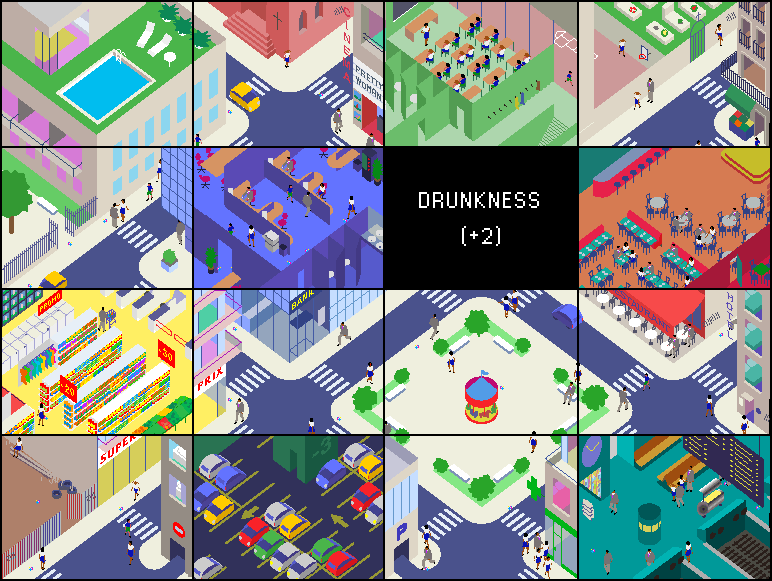
I recently came across this video surveillance game called Vigilance 1.0. The player is tasked with maintaining morality and order by monitoring surveillance cameras and denouncing any digressions. They player is rewarded for punishing anyone caught in the act of "
robberies, pocket-pickings, burglaries, shop-lifts, breaches of the highway code, trash-abandoning, drug dealing, solicitation on a public place, procuring, drunkenness, sexual harassment, adultery, incest, pedophilia, zoophilia, necrophilia, etc."

The art-game's description and game play are intentionally tongue and cheek. There is no winning as the game continues indefinitely and the system arbitrarily assigns point values to crimes (+2 points for prostitution, +10 for bagsnatching, -1 for false allegations). The game's developer makes the claim that for the player, the game is "
At the end, the denunciation of a controlled society, the total visibility and spying, putting him in a position of self-denunciation." Ostensibly the game aims to question the role of people in controlling and capturing in society. The player is cast not as a criminal avoiding constant surveillance but as a security guard faces with the responsibility of upholding justice.

Through Agre, Foucault, Deleuze and Virilio, our discussions of surveillance have focus on the structures and networks of "control society" and the "REALTIME" of the contemporary world. Examining this game also makes me wonder about the possibility for individuals to decide whether or not they want to enforce the networked mediated systems of control, or whether as this game seems to hopefully suggest, it is as much the system (the structures, networks and media) of control as the the agency of the people enacting that system.

Tuesday, May 6, 2008

(very) late post on jameson

Jameson suggests in “Cognitive Mapping” (from Marxism and the Interpretation of Culture) that within the space of the postmodern era, all voids and gaps are filled. As “the truth of experience no longer coincides with the place in which it occurs” (349) the individual who experiences this new space becomes schizophrenic. (For this schizophrenia, similar to the disorientation of the subject within Virilio's visual crash, the solution for which Jameson searches may also help to prevent or at least soften the visual crash.) Jameson seems to hope that his aesthetic of cognitive mapping will intensify the individual subject's sense of place in the global system and rescue him from his schizophrenia. Manovich's navagable space of new media is then a symptom of the fragmentation and schizophrenia that Jameson speaks of because the navigator must jump from one discrete object to another to move through it.

Jameson's political agenda here may also relate on some level to Deleuze, who insists that “the crisis of the institutions, which is to say, the progressive and dispersed installation of a new system of domination” calls for “new forms of resistance against the societies of control.” (Postscript on the Societies of Control, p. 7) However, Jameson's desire for totality seems reactionary and perhaps a bit conservative because he assumes that, in the postmodern era, the individual may be completely detached from the local and consumed in the global experience, and if so, that this is a bad thing which must be met with a solution. Unlike Haraway, who embraces the evolution toward the cyborg and the pastiche of postmodern experience, Jameson calls for a return to a more traditional local sense of place within the global system, rather than the saturated global sense.

Friday, April 25, 2008

Stallman's Ethical Non-treatise

I appreciate the “humanistic” ends of Richard Stallman’s GNU Project, but I think that the GNU Manifesto’s rhetoric is too moralizing and reads like a sophomoric expose on open source ethics. While I can empathize with Stallman’s enthusiasm and (less so) with his messianic urges, I wish he would run his manifesto through an open source program that removed statements like “…if programmers deserve to be rewarded for creating innovative programs, by the same token they deserve to be punished if they restrict the use of these programs” and “’Control over the use of one’s ideas’ really constitutes control over other people’s lives; and it is usually used to make their lives more difficult” (5,6). Why all the unfounded confidence about what is good and what is evil? Why all the normative claims (drawn out in an annoying question-and-answer format)? Not everyone is/should be a stout observer of an embarrassingly watered-down Stallman-Kant ethical paradigm. Why is Stallman calling forth on it to save his a**? There are ways of constructing more convincing arguments, especially for what seems like such a promising idea, without assuming the role of Answer God or making ethical judgments. But perhaps I have just assumed the role of a certain Debbie Downer at this late hour.

Anyway, take care, ya’ll.

Thursday, April 24, 2008

here, at the end of things

I have to say these last readings were pretty dull. As we have (among other things) been discussing all semester, the development of the internet is an incredible thing, particularly because of the way it allows collective action of one form or another. While I'm sure people like Stallman are brilliant in their respective fields, this stuff is dense with outdated jargon and palpable smugness (and why does that one guy keep talking about hacking?), which is annoying even when it's justified. I'll admit that I'm more or less completely ignorant when it comes to programming, so I may have missed the point completely, but all these just seem like examples of the globalizing force of the internet, viewed from the inside of the machine rather than the outside. Programs become obsolete and are replaced by new models, and so on--I believe the idea of software as text is wonderful, and I hope that the internet really will allow people to connect in a kind of cyberpunk fulfillment of the '60s hippie dream, but I don't see it happening just yet. These articles read like pictures of turning cogs--they will become part of the history of the movement, and remain important, but I don't see how they're enlightening or even particularly interesting to anyone except a mechanic.

Yes, anyway, it's been fun.

In Defense of GNU

While I think Richard Stallman is an ass, I do not think he's wrong. I think a number of people are misunderstanding what free software is about. Shane compares free software to free paint, though I would argue that this is a misinterpretation-- paint is both rival and exclusive while the ideas behind/surrounding a painting are not. (In fact, it's worth noting the differences between rival and exclusive goods:
* Non-rival/Exclusive - my consumption does not preclude yours, but you can be prevented from consuming by the producer. e.g. Concert
* Non-exclusive/Rival – cannot prevent you from consuming, but your consumption (in principle) precludes mine e.g. drinking water from a public lake
* Non-rival and non-exclusive: Cannot prevent access (for practical purposes) and consumption of one doesn’t preclude consumption by someone else. e.g. street lighting.)

It's actually interesting that Shane brought up art in the context of open source software because the open source 'ideals' have been brought to the art world where many artists argue for the ability to freely appropriate art to create more art. This GNU-like licensing model has inspired the Creative Commons movement (http://creativecommons.org/).

Stallman's ideas are quite applicable to many products of our intelligence (not only software and art.) Unlike most people in the class, I think he is right. I open source most of the code that I write for my computer science classes (e.g.: http://code.google.com/p/racemakr/ , http://code.google.com/p/collagemakr/ , http://code.google.com/p/lifethreads/) as well as the art that I create (e.g.: https://wiki.brown.edu/confluence/display/mcm0750/Computational+Algorithm#ComputationalAlgorithm-001 , https://wiki.brown.edu/confluence/display/MarkTribe/d%27Entre+les+Morts )

Stallman has some attitude

In The GNU Manifesto, Stallman writes that “extracting money from users of a program by restricting their use of it is destructive because the restrictions reduce the amount and the ways that the program can be used.” Here, Stallman has unhelpfully reworded the Law of Demand in sensational terms. Of course charging a price for something means that fewer people will use it, but this is how our economy functions. It seems that Stallman is unhappy having to pay for anything, and would prefer to live in a society where everyone works hard for everyone else without quantified incentives. Perhaps with software, it is particularly realistic to expect that we might actually move in this direction. If so, then the GNU Manifesto is really just a practical case of a much larger manifesto against capitalism in general.

The examples of free labor we have discussed so far seem largely to be fundamentally secondary activities. We may labor for YouTube by posting content to their website, but one could not pursue YouTube posting as a full-time job. It seems that producing free software must also remain secondary to the business of proprietary software. If the software industry were entirely open source, I would expect that there would be many fewer professional programmers. And if GNU is destined to remain secondary to proprietary programming, then I don’t see why Stallman must make the relationship between open source and proprietary software sound so antagonistic.

The GNU all seems a little self righteous and impractical. I understand Stallman's 'moral' qualms with charging people for things that can be used for the betterment of society, but to say that a programmer would be selfish to desire reward for his work is just absurd. The truth of the matter is that we live in a capitalist society and that means money and competition are everything. The amount of talented programmers there are right now is because of the fact that programming has become such a successful career. If you cut their paycheck then the amount of people desiring the job will diminish significantly. I think it would be great if advertising and donations could support the necessary staff to keep up with today's demands, I just don't think it is feasible. Another thing that must be considered is the fact that if people want free software it is easy enough to get it. Most softwares only require a serial number and those are not difficult to get a hand on. I agree that the system now is not great, the prices for most software are outrageous. However it is a cycle, the high prices force people to download softwares illegally. Through doing this though they also keep the prices high. So I am not sure what the perfect system is. It would be great if programming was paid through fame and recognition, and that the programmers could all be paid their fair share. In the end their job is extremely important for the world because they do in fact make many jobs way more productive through their softwares. They impact many markets and many lives, so they should be rewarded in some form. I just think Stallman has gone a little too 'free' in his idea, especially for the western world.

Free Beer is Free Beer is Free

I too think that GNU's shift to regarding open-source software as like free speech instead of free air or free beer is disingenuous. When source code becomes both available to read and legal to study, the costs of engineering an analogue — a closed, proprietary copy — drop dramatically. At the heart of the source are the algorithms, which are ideas more than code, and once these are read and distributed, other companies can use them as they see fit. This is one of the main reasons why "free as in free speech" often just ends up meaning free beer. There are hardly any companies which make their profits directly off open-source software; they usually give it away and sell support. Stallmann should get off his high horse.

terranova and social factory

i was interested in the idea of free labor and the social factory that terranova brings up in one of the readings. terranova describes the “social factory” as "a process whereby 'work processes have shifted from the factory to society, thereby setting in motion a truly complex machine.'" this social factory seems to just follow up and continue in the tradition of the way discipline implicates itself into society in Deleuze's postscript on societes of control, and additionally, to the way google turns work into play and play into work and how user-generated content (like on youtube) is produced in the guise of play.